Showing posts with label Literature. Show all posts

Friday, September 3, 2021

Fiction Friday (140)


In my continuing exploration of contemporary literature, I recently read the National Book Award Winner for 2019. This was the last book that I'll be reading for the Book Club I've been hosting at my current job, as I'm moving to another library at the end of the month. I really appreciated the exposure to the so many compelling current fiction over the course of the year, but am certainly looking forward to getting back to reading books of my own choosing.

The Friend by Sigrid Nunez

(Riverhead Books, 2019)

When the unnamed narrator of the story loses her longtime friend to suicide, it begins a journey of grief in which she tries to comes to terms with both the actions in her own life and those in his that may have led to this painful incident. The novel is presented in the form of confessional letter written to her dead friend in which she explores their relationship, his relationships with past lovers, and the experience of writers, both herself and the deceased. 

The books is fragmentary, with no real defined narrative or plot. It reads like a diary in that it's a series of thoughts, sometimes connected, sometimes independent. As a writer, I found the insight on the life of a writer, and the publishing world, to be profound and truthful to my own experiences. It's exploration of deep friendship and how it works in waves of intense closeness and periods of distance, are also exceptional and honest.


Friday, July 2, 2021

Fiction Friday (136)


My exploration of contemporary literature continues with the latest book by Pulitzer Prize winning author Jane Smiley's new book which came out in December. This was another Book Club book, and one that I was excited to read. It's been a while since I read any "talking animal" literature, probably too long given me affinity for the sub-genre. It's also been awhile since I read a book that so was joyful...something I do actually enjoy every now and then.


Perestroika in Paris by Jane Smiley

(Knopf 2020)

When a racehorse named Perestroika (Peres) wanders away from the track one evening after a win, taking with her the purse containing money won on her victory, she is simply following her curiosity and the patches of vegetation that lead her eventually the Champ de Mars in the shadow of the Eiffel tower. The filly's unlikely journey leads to a more unlikely adventure with the unlikeliest of friends; an intelligent stray dog named Frida, a raven, two ducks, and lovable rat named Kurt. 

This delightful novel follows these animal friends over the course of an autumn, winter, and spring as they use the money to purchase food and eventually end up living with an eight year boy and his nearly hundred year great-grandma. Smiley invites into the intimate and fascinating world that exists unnoticed by most, and once you've visited, it's unlikely you'll want to leave.

A novel that has a classic feel, told with unquestionable skill.


Friday, June 18, 2021

Fiction Friday (135)


The cultural revolution of the 60s saw many writers examining things that had been left untouched for a long time. There was a wave of fiction that tried to tell the stories of characters who didn't fit the norms. Recently, my library weeded a large number of books that had fallen out of circulation and this is one of the many that I saved from the dumpster. I was attracted by the old style cover, but was soon taken by the story. The last 20 pages are pure beauty.

Tell Me That You Love Me, Junie Moon by Marjorie Kellog

(FSG 1968)

Warren, Arthur, and Junie Moon are three tortured souls who meet in the hospital while recovering from ailments. When these "misfits" make a pact to leave the hospital and live together, no one really believes they will make it. 

Confined to wheelchair after being shot in the back by the only man he ever admitted his love to, Warren is the unofficial leader of the group and the catalyst for almost everything that happens to them. Arthur suffers from a degenerative disease that doctors cannot identify, but perhaps is more plagued by the hurt of abandonment. Junie is a tragic figure who has had her face and hands disfigured by acid burns from a troubled lover. The are individually damaged, but together seek to heal as they move into a rundown house under a large tree that serves as a kind of protector.

Healing is hard, as they soon discover. Healing hurts. But what they find is a sense of belonging with each other, a sense of family which none has ever truly had. They find love and more importantly, acceptance.


Friday, May 7, 2021

Fiction Friday (131)


There are a handful of figures that have shaped my creative pursuits in my lifetime, one of them being Henry Darger. I still remember my first encounter with his artwork, from an ArtForum article in the late '90s and my interest has never waned. I recently have been listening to an album inspired by his words are art, which made me curious to search for books and I came across this 2019 novel which incorporates him as a character. It more than lived up to my expectations.


Curious Toys by Elizabeth Hand

(Mulholland Books, 2019)

Pin is a fourteen year girl living in the dangerous city of Chicago in 1915. The city is a particularly dangerous for girls during that summer. After the murder of Pin's younger sister, her mother insists that Pin disguise herself as a boy for safety while they are living at the Riverview Amusement Park, a bustling Coney Island equivalent. Pin relishes the freedom that comes with being a boy, though lives in constant fear of being discovered. Her fears are exasperated when one day she witnesses a young girl enter the "Hell's Gate" ride with a man, and only the man emerges when the boat comes out. 

She's not the only one to witness this crime. A odd man named Henry Darger (based on the Outsider Artist) also saw the girl enter and not come out. Together, the two characters form an unlikely pair looking to capture the killer and avenge the deaths of his many victims. 

This was a spellbinding novel that really delved into many aspects of psychological disorders. There is care taken in presenting these characters in an understanding and thoughtful way. The "disturbed" are given a humanity, no matter how terrible they may be...and that's the joy of the book for me. And Pin is one of those wonderfully brave characters that you'll never forget.


Friday, March 5, 2021

Fiction Friday (127)


Having avoided contemporary fiction for most of my life, I've taken a keen interest of late. In the past year, I've read no less than four truly remarkable novels that have been published in the past few years. There seems to finally be a movement back to literary fiction after decades of fluff. There are several more novels on my must-read list, but I'm pretty close to convinced that this movement is true. My latest read was phenomenal. 


Piranesi by Susanna Clark

(Bloomsbury, 2020)

In the year the Albatross Came to the South-Western Halls, many extraordinary events happen within the labyrinthine halls the House. There are but two occupants of the House, as well as 12 former occupants whose bones are all that remain among the infinite statues and tides that flow through the halls and vestibules. 

Piranesi keeps a record of his days spent collecting fresh water, seaweed to dry, and offerings for the bones. He is the keeper of the labyrinth. He is one blessed by the House with its kindness. He interacts with The Other on two weekly occasions, but The Other is quite different than Piranesi. The Other is search for the Great and Secret Knowledge he believes is contained within the halls of the House. But of the course of the year the Albatross Came to the South-Western Halls, Piranesi discovers The Other is the one truly holding secrets.

There are but a few stories that attempt, and succeed so perfectly, in creating a world completely different than our own. From the opening pages, Susanna Clark fully immerses the reader in a foreign reality. It so carefully constructed that you don't feel yourself being pulled into it, you simply arrive...much like the main character. And that is the true gift of this novel, that the reader shares each discovery with Piranesi without ever knowing more or less than he.

This mesmerizing and unconventional mystery is a true masterpiece.


Friday, February 5, 2021

Fiction Friday (125)


There are certain books in everyone's life that it puzzles them that they had not already read it. For my entire adult life, I've explored the catalog of Grove Press, have been inspired by novels that tear away convention, and devoured books that examine the taboo thoughts that we all conceal in our minds. Yet somehow, I'd never read one of the pillars of all three of those criteria....I have now.

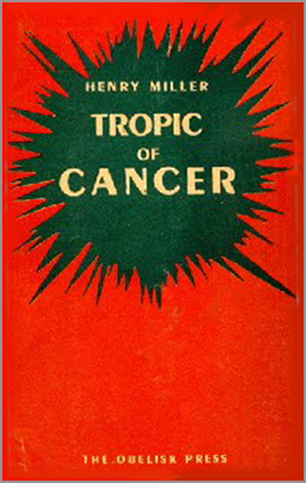
Tropic of Cancer by Henry Miller

(Grove Press, originally published 1934)

There are few works of art that one could call revolutionary. This is one of those. Part autobiographical, part philosophical diatribe, part fiction, and pure brutal honesty, this novel was considered dangerous when it was published in Paris and was banned in the U.S. for nearly 30 years. 

Deemed pornographic, its publication was forbidden in the land of the free. But this is far from pornographic and the real reason was probably due to the way it rips open the idea of America to examine it from the inside out. It is a response to Whitman, a precursor to Ginsburg's "America", a raw description of what it means to be American, what the ideal of freedom means to one man living in Paris between the wars and exploring the underground world of ideas and art that were born from conflict and destruction. 

But it's also about the soul, the darkness that festers there and the beauty that can be illuminated even in that darkness. This novel is the the birth of Post-Modernism, the birth of the Beats, the birth of the French new novel. It is a big bang in the world of literature that spawned ideas and creativity that would dominate the literary world for more than half a century.

In short...it is a masterpiece.


Friday, January 8, 2021

Fiction Friday (123)


The first book finished in a New Year is typically a good one for me. It's usually a book that I've wanted to read all year, and I'm counting on those holiday days (especially the 2020 kind) to let me read. Though this wasn't my first choice, this was the book I needed to read for my book club. It was cool though, because I've read some of Erdrich's work and really respect her writing. Love Medicine was a book I had to read in AP English in High School back in '93. It was unlike any book I had read before. I read The Antelope Wife when it came out and loved it. It seemed a more than fitting time to catch up.


The Night Watchman by Louise Erdrich

(Harper, 2020)


In 1953, a Reservation and its people were facing termination in the US Senate. It was given names that made it sound like a good thing, calling it emancipation and elevation, trying to cover up what it really was by wrapping it up in shiny paper. This is a document of how they saved their lands from extinction and protected what was rightfully and lawfully theirs.

Through a host of varied characters, the reader is brought into their lives like an observing spirit. You spend time with them, sometimes doing only ordinary things, but things that feel important. The reader feels connected, feels the pain inside each character, and knows they are strong enough to survive. That's what great books do. Great books create shared experiences between the reader and the fiction. This is a great book.


Friday, December 18, 2020

Fiction Friday (122)


One of the few things I will always remember about this long cold winter of homesteading is that I've been able to read more. Coupled with the fact that the library has is literally overrun with new titles, and my newfound interest in contemporary literature, it's was a good post Thanksgiving reading week. Enjoy.


August by Callan Wink

(Random House, 2020)

August. A character title is just about perfect for a novel that attempts to, and pretty masterfully succeeds in, capturing the complete essence of a character's life.

We meet August before he's even born. We meet him the moment his mother decides his name will be August. One's essence doesn't start at birth, it starts when you have a name. Names are powerful in shaping one's character. Now that empty container has a label and something to live up to. This is August's search to discover what being August means.

The novel is written in what almost feels like linear slice of life pieces strung together with scene breaks. They are brought to life with carefully crafted moments that allow the reader to spend time with August. It's a fly on the wall perspective, a camera lens kind of straight forward storytelling in a style that reminds me of many of the late 20th century greats.

It's the kind of book that's not really about anything, because it's really about everything. It's about parents and first relationships, and not understanding what any of it means to a teenager becoming an adult. It's a book that will stay, always wondering how August is doing these day.


Friday, December 4, 2020

Fiction Friday (121)


I've mentioned before how one of the joys of working in a library is the thrill of random discovery among rows and rows of books. A few weeks ago, I was grabbing something off a shelf and was caught by the title of this book. I made a note and then when I had finished the last book I was reading, I went back for it.

The Dead School by Patrick McCabe

(Delta, 1995)

This is the tale of two men of two generations who experience similar trauma as children, but whose lives take very different paths. One becomes a celebrated Headmaster of a boy's school in Ireland. The other becomes a not-so-dedicated teacher at that school years later. Their lives intersect and from their very first meeting, both are thrown onto different courses than each had planned. Though very different in regards to morality, views on life and culture, and societal values, Raphael Bell and Malachy Dudgeon's lives mirror each others in many ways. Neither ends up turning out too great.

This is a portrait of struggle, the struggle to remain in the present as the world moves on without you. The struggle to reconcile mistakes, and achievements, of the past with the present. It is a story about the rippling effects of tragedy on the individual and those around him. It's also a historical look at a changing society in a notoriously stifling culture that was Ireland in the 20th Century. 

This is one of those books that started off slow, but begins to dig into your thoughts until it eventually consumes your attention.


Friday, November 20, 2020

Fiction Friday (119)


Oh, that shiny new book appeal, far greater than the appeal of new cars, and somewhere right up there with new records. After months of playing the waiting game, my library finally placed a sizable order for new books about a month ago, books that have since been cataloged and placed on the shelf. I was nosing through them last week when one exceptional cover caught me eye. I did what I always do in that situation, I read the flap copy and if it appeals, I flip to the middle and read a random paragraph. I was sold instantly on this one.

A Children's Bible by Lydia Millet

(W.W. Norton, 2020)

Parents are shapeless masses drowning in alcohol, drugs, and a yearning for their youth. They are worthless in the eyes of their children. Children who have been dragged along for a months long reunion of matured college friends. Children left to entertain themselves while the grown friends wallow in all the pointlessness of grown-up life. 

The mansion where they are vacationing holds little appeal for the children, ranging in age from 10 to 17. It is an old fashioned mansion in an undisclosed location that resembles the Hamptons, or the Cape, or anywhere not too far from the sea where rich people go to spend their time. Of course, devices were confiscated so that the children could appreciate the time, but it only ends up adding to the alienation they feel toward the older generation.

Then the storm comes.

Millet's sublime writing enriches this perfectly crafted novel, elevating it truly biblical proportions. Part Lord of the Flies, part Oryx and Crake, part  The Road, this novel's scope and power build so carefully that they settle upon the reader like a wave that gave no indication of its arrival.  An absolutely stunning novel that I don't expect I will ever forget.

Friday, September 25, 2020

Fiction Friday (115)


My summer of Wonderland continues as I just recently finished reading the second book in Christina Henry's re-imaging of Alice. While the first book was a gripping, this one was entertaining if not completely revelatory. Definitely a must-read for readers of Alice to see the tale to a satisfying conclusion.


Red Queen by Christina Henry

(Ace, 2016)

Having defeated the Jabberwocky and escaped the horrors of Old City, Alice and Hatcher find themselves in a strange world that is unlike the city...with the exception of danger and odd happenings around every corner. The desolate landscape has been scorched by a mysterious figure in black, the surrounding forests are patrolled by flesh eating giants, and the inhabitants of the only town grieve the loss of their children. Welcome to the kingdom of the White Queen!

The White Queen rules from a icy castle atop the mountains, a castle protected with stolen magic. The White Queen takes pleasure in causing misery for others. But when she attempts to derive pleasure from Alice's misery, she isn't prepared for Alice's determination, or the magic she holds within her.

The follow-up to Alice, this is another great read for fans of Wonderland. However, this book lacks the true horror that the first one conjured up, choosing instead to dwell more in the world of fairy tales. It was the brutality that made the first book so unique and memorable, but this one is solid. At times it falls into repetition, almost as if the writer doesn't trust the reader to remember key details. I found that slightly distracting, but still very much enjoyed this trip into Wonderland.

Friday, August 28, 2020

Fiction Friday (112)


Per my last Fiction Friday, I spent two days picking one-night reads while waiting for my library books to come in. This is the second of those books. I went to my shelves of unread books, looking for the skinny ones and found this book. The odd thing is, I have no recollection of ever acquiring this book, or even seeing it before. I have no idea where it came from, but there was a Ray Bradbury quote on the back that says this book gave him flight, and made him young. That was enough for me.
 
 
Jonathan Livingston Seagull by Richard Bach
(Avon, 1973)
 
Jonathan Seagull is not like the other birds in his Flock. He believes life is more than scrambling and fighting for crumbs. He believes life is the art of flying. He seeks the perfection of flight, beyond the physical limitations of being a gull. He seeks freedom.

This is one of those meditative stories in the tradition of The Little Prince, Siddhartha, or The Prophet...all books that I have loved. It's a story whose meaning lies beneath the surface story of a bird that travels through planes of existence on a path toward something spiritual. It's about community, about loving those who scorn higher pursuits or reject the herd mentality. 

Beautifully sublime and moving. Illustrated with black and white photographs by Russell Munson, the pictures work with the story to give you a sense of weightlessness. One of those little gems that takes only an hour or two to read, and stays with you much, much longer.

Friday, August 14, 2020

Fiction Friday (110)


I recently put together a presentation on Alice's Adventures in Wonderland that I did for my library. During my research into books based on Alice, I found several books that I didn't know about. This surprised me since I'm a die-hard fan and thought I knew about most Alice related stories. I immediately put in a request of the first of what I expect to be an autumn filled with Alice. This one was stunning.


Alice by Christina Henry
(Penguin, 2015)
 
Alice is a broken girl in a broken world. The story opens with Alice as a young woman in a dismal mental hospital that is more like an 19th century prison. The hospital is in "Old City", a fantastical, Dickensian slum. Alice is from "New City" which we never see, but gather is a place of considerable more refinement. There is time period assigned to this world, but it feels very Victorian era.

Alice hates the hospital, but it is safe from the dangers of Old City and the criminals who run it, trafficking in girls and violence. It is also save from her memories of The Rabbit which left her hideously scarred. Plus she has Hatter, the scruffy man in the next cell whom she talks to through a mouse hall in the stone walls. But the hospital hides a secret buried below...a dangerous creature known as the Jabberwocky. Then one night, a fire breaks out, unleashing the Jabberwocky on the people of Old City, not to mention Hatter and Alice.

This is dark fantasy with noir elements, set in a world of almost unspeakable brutality. But as foreign as it is to Lewis Carroll's world, Christina Henry still captures the spirit of Alice and wonderfully integrates and re-imagines the elements of Wonderland into a compelling story that feels related enough to be part of the cannon. There's a second book in the series that I'm currently on a waiting list for.

Friday, August 9, 2019

Fiction Friday (85)


One of the many great benefits of working in a library is the constant exposure to books that you may otherwise have not encountered. Or rather, constant access to books you may otherwise have allowed to sit on a To-Read shelf for years until coming across a copy. I've always felt that I needed to read more Japanese literature, being such a fan of so many other art forms from the culture. In the 20th century, the Japanese had many great writers who rivaled the French in their approach to the new novel format. Having spent the last twenty years devouring the French writers, I figured it was time to delve into the Japanese.

The Ruined Map by Kobe Abé
(Knopf, 1967)

There was a time in the late 60's and early '70s when Knopf ventured into the world of avant garde literature that was featured on lists by Grove Press and New Directions, and managed to release quite a few now nearly forgotten masterpieces (most notably The Demon Flower by Jo Imog). Though surely not forgotten in its native Japan, this is one of those novels that fits the mold.

In the style of Robbe-Grillet's The Voyeur and Erasers, this is a fragmented detective story on the surface. It follows an unnamed narrator, a detective hired by a woman to find her missing husband. During the course of this futile investigation, the narrator consistently receives unreliable information that leads him in circles, never bringing him closer to his objective. Written in first person, the narration leaves the reader in the same sense of confusion, never quite sure what exactly is going on, but completely aware that there is more going on than either we or the character knows.

The noir facade serves as a metaphor for the loss of identity occurring in the rapid expansion of Tokyo in the late 60's. The sterile suburbs that are being manufacturing seemingly overnight hide the seedy underbelly working behind the scenes, allowing people to easily ignore that it's there. But in the process, they are equally unaware of the manufactured world's ability to erase them out of existence. The sameness of scenery, the blandness of life, all work against the human spirit until one simply disappears into the void.

This was the type of book that one should read slowly. There's a lot going on that remains unsaid, forcing you the really exercise your reading skills. But if you do, it's certainly worth it.

Friday, July 26, 2019

Fiction Friday (84)


It's that time again, time to spew my thoughts on another book that I've read. This is a book that had been on my "To-Read" list for over 20 years. I came across a free copy recently and decided now was as good of a time as any. I have to say that this is a book that I'm glad I didn't pick up as a teenager (the age when I think most people probably read it), because there is a complexity to it that might get lost. A teen reader would certainly be able to understand Ender's frustrations, but not sure they'd be able to fully appreciate the actions of the adults and the difficulty they had in making their choices.

Ender's Game by Orson Scott Card
(Tor, 1984)

Ender is a child, only in body and years. The truth is, Ender never had a childhood and was never destined to have one. He is a Third in a future where two children is the law. He was allowed to be born for one purpose only, to become the ultimate weapon in humanity's war against the "buggers", and alien race that had twice invaded our solar system, and twice failed.

Unable to conceive of an enemy that would abandon its desire to destroy, and unable to communicate with the enemy, humans have launched an invasion of their own to destroy the buggers before they return to destroy us.  As the ships are own their way, armed with an ultimate weapon, the race is on to train the perfect commander. As time runs out, Ender Wiggin is the last hope.

Unlike many sci-fi novels that I've read, this is beautifully written and holds literary value. It is able to bring the action scenes to life, but also reveal Ender's inner turmoil. A very powerful story that stays with the reader, leaving him or her to contemplate the moral complexity and ambiguity that exists in this very plausible vision of a future that could come to be.

Friday, June 21, 2019

Fiction Friday (82)


When I was choosing my next book to read a few weeks back, I decided to dig into the "to-read" shelves in my office and came across my signed copy of After Alice. Having been a huge Alice fan since my teen years, I was partially surprised that this has sat on my shelf for four years. Having just finished reading Alice's Adventures in Wonderland to my daughter, and it still fresh in my mind, it seemed like a good time to read this.

After Alice by Gregory Maguire
(William Morrow, 2015)

 In Alice's Adventures in Wonderland, Alice mentions one friend and mentions her exactly once. Her name is Ada, and all we know from Alice is that she wears her hair in ringlets. From that one glimpse, Gregory Maguire gives us this novel. Now, it's not that surprising as he's made a career out of spinning out stories from classic children's literature. What struck me about this book was how he was able to grasp the parameters of Lewis Carroll's world and expand on it in such a precise way that makes the reader feel as though they are inhabiting the same place, unlike say, The Looking Glass Wars which re-invents Wonderland.

Alternating between Ada's attempt to navigate Wonderland, and the frantic search happening in Oxford on that fateful summer day, this book, while slow to begin, becomes entirely engrossing after the first 50 pages or so. It's as much a commentary on Victorian society as it is an examination of the peculiar imaginary land. 

We've only ever seen Wonderland through Alice's eyes, a child who is strong-willed and confident. Ada is a very different child, and her perception of this place gives us new things to consider. I found this book to be extremely well-written (though the author does tend to be a bit pretentious a times). His inventions of Wonderland fit seamlessly with the original, something that was not easy to achieve. I would say this is a must read for serious Alice fans.  

Friday, December 21, 2018

Fiction Friday (74)


On the next to last Friday of the year, I've finished reading another book. This is one that took me quite some time to get through as I tried to savor it's brilliance. At this point in my life, there are fewer and fewer pieces of art that truly amaze me, be it literature, film, music, or otherwise. That isn't to say I've lost my sense of amazement, simply that my experiences have exposed me to the vast underground of forgotten art and there remains very little stones to be unturned. But there are still hidden gems out there and when I find them now, my enthusiasm for the discovery is even greater.

The Journal of Albion Moonlight by Kenneth Patchen
(New Directions, 1961)

Originally published in 1941, this is a post-modern novel before the term really existed. It's clearly twenty years ahead of it's time and reads like a foundation for books by Burroughs and Pynchon and the French new novel movement of the '50s, though shockingly American in every way.

Set against the backdrop of WWII and the rise of fascism, this surrealist novel examines the war that takes place endless within the psyche, both of the individual and society. It breaks all conventions of plot and narrative structure as it attempts to break open the conventions of novel writing, which Patchen (primarily a poet) seems to hold in low regard.

In many ways, this feels like an accessible Finnagan's Wake in that it is a love of language, a tribute to the written word liberated from the weight of plot and character development. Anti-capitalist, anti-fascist, anti-conventions, this is still a profound novel almost 80 years after it's publication, so I can just imagine the total shock it caused when it debuted.

Friday, September 21, 2018

Fiction Friday (73)


Now that grad school has officially ended for me, I've had a little more time to read books of my own choosing, and considerably less scholarly journal articles. I've actually read another book before the one below, but haven't had the right frame of mind to give it a proper review (which will come soon). This is a book I've been wanting to read for a long time, but an author that I really admire and who was a big influence on the modern novelists that emerged in Paris during the first half of the last century. This is probably more accessible than some of his other works, so if you're looking to explore his writing, this is not a bad place to start. Enjoy.

Gold by Blaise Cendrars
(Marlowe & Company, 1960)

Gold is a deceptively thin first novel by the pioneering, and widely forgotten but influential Swiss/French author. Though it's not long in length, it surely covers a lot of area in its depth. In many ways, it follows the the early 20th century trope of a rags to riches story, but in typical Cendrars fashion, it turns that trope on its head.

This is one of the earliest attempts at Historical Fiction that I'm aware of, as it takes the life of the real John Augustus Sutter, a pioneer in California and the discoverer of gold that led to the famed Gold Rush of '49. Cendrars portrays Sutter's life as more tragic than it actually was as a way to strengthen the themes of the novel centered around fate, justice, and the futility of fighting against the first or for the latter. 

Sutter had come to America as a penniless immigrant, and eventually makes his way to the violatile land of California where he establishes several successful enterprises on a huge swath of land granted to him by the Mexican government (then controllers of California). By the time California is part of the U.S., Sutter is on the verge of becoming the richest man in the world...and then gold is discovered on his vast properties. When the discovery leaks to the rest of the world, it spells the ruin for Sutter, who watches all he built quickly taken over by the flood of people coming to search for gold and build towns and cities on land that was rightfully his. 

Fully engrossing and surprisingly moving.

Friday, August 31, 2018

Fiction Friday (72)


So the long weekend is about to begin and I'm starting it off by beginning to read a new book thanks to having finished the most recent one I was working on. This was a book given to me, something I always a little nervous about, but the idea of little elephant was irresistible. I began it immediately, and was rewarded by a good story by an author I was unfamiliar with, which is always exciting. 


Elefant by Martin Suter
(4th Estate, 2018)

This is the story of a genetically engineered elephant and the people who seek to profit from her existence, as well as those seeking to protect her from them. It starts a little slow, but as the two timelines of the story converge, the story becomes engrossing as it examines the trappings of success and the pressure to succeed. Disguised as a semi-thriller, this is really a book that takes a look at bigger issues like the moral implications of genetic engineering, the role of God, and the way people deal with troubling events in their past. The common thread that weaves through these themes is the tiny miracle elephant that glows in the dark. 

Well written and excellently executed pacing. I felt the characters were a little flat, or not so much flat as they were pretty standard in their views and range. They didn't feel like new and interesting people. That said, I really enjoyed this book, just felt that the writing could have been more profound. However, given that for nearly two decades, I've been wishing for "a really little elephant", this was probably the perfect book for somebody to give me.

Friday, June 15, 2018

Fiction Friday (70)


It's a break before my last quarter at grad school, which has given me a brief respite to do some reading that was not based on peer-reviewed academic articles, and so I dove into this thin volume from one of my favorite French writers of the first half of the last century. A more serious book than some of Queneau's other more popular works, but still excellently written and equally captivating. This is a great author for people looking for someone they may have never read before. I have yet to encounter a book of his that I didn't enjoy.

Odile by Raymond Queneau
(Dalkey Archive, 1999 originally published 1937)

How does one fill the emptiness that has been left inside after the experiences of war? How does one search for meaning in a world where humanity feels bankrupt? These are the questions at the heart of Queneau's novel about a young man in Paris during the years following the first world war. Somewhat absent the usual wit and playfulness of many of his other works, this is a more serious look at human society (though to be sure, flashes of his wit and playfulness do show through). And while this novel is about a specific place and specific time, the overarching themes serve us well in our current climate of post-truth and increasing cultural bankruptcy.

The cast of eccentric characters who populate this novel embrace the politics of socialism to satisfy their unhappiness. But they never embrace the ideals of the movement, only the idea of being part of the movement while they find ways to subvert it and turn it into a game that attempts to create meaning, purpose, and amusement in their lives which feel rudderless. Travy, the main character, never fully commits to the charade, only to the destiny of unhappiness. As is often the case in life, love becomes the great equalizer, helping him to recover his sense of humanity and discover what the true meaning of life must be, because love is the only true thing we have.